
The Situation
You can feel it.
You cannot point at it.
Most hospital CEOs I talk with already know their operation is giving something away.
Agency spend that never comes back down. A staffing model nobody can defend. The same three problems solved again every month. Departments that all say they are short, and no way to know which ones are right.
What they cannot do is put a number on it, and hand that number to someone who can go close it.
Where the gap comes from
This is not always a leadership problem
Our industry takes the best clinician on the unit and makes them a manager.
Then a director. At no point does anybody teach them to run a business unit.
Then we hand them a budget they did not build, a staffing model nobody explained, and a set of metrics they are accountable for that were never on their license.
They are good. That is usually why they got the job. They have never been trained in the part you now need them to be great at. That is not their failure... it is a gap our whole industry built, and it is the most fixable thing in your building.
How the work runs
There are two halves to this
The first is a few days in your building. I walk your operation with the leaders who run it, teach them what I am looking at while I am looking at it, and five business days after I leave you have a twelve-month plan with dollars attached to every line.
The second is the twelve months after that, working that plan with your operational team, once a month, from wherever I am.
You can take the first half on its own, and plenty will. The plan says in writing which items your own leaders can run without me, and most of them can. You decide about the second half after the plan is in your hands, not before.
The first half
The Operational Performance Intensive
A few days in your building. I walk your operation with the leader who runs each area, and teach them what I am looking at while I am looking at it.
Five business days after I leave, you have a twelve-month plan. Every opportunity quantified and sequenced into Now, Next, and Later, with a number on every line.
$25,000
Travel and accommodations included across North Dakota, South Dakota, Nebraska, Kansas, Minnesota and Iowa
The first half
The Operational Performance Intensive
A few days in your building. I walk your operation with the leader who runs each area, and teach them what I am looking at while I am looking at it.
Five business days after I leave, you have a twelve-month plan. Every opportunity quantified and sequenced into Now, Next, and Later, with a number on every line.
$25,000
Travel and accommodations included across North Dakota, South Dakota, Nebraska, Kansas, Minnesota and Iowa
The first half
Twelve months with your
team
Implementation, not instruction. Your directors run the changes in the plan. They are the ones standing in front of their own staff.
I am a phone call. Once a month with the group, and reachable in between. Expertise in their back pocket, and nobody new in your
hallway.
$3,500 a month
Twelve months. Priced separately, and decided after the plan is in your hands
The second half
Twelve months with your
team
Implementation, not instruction. Your directors run the changes in the plan. They are the ones standing in front of their own staff.
I am a phone call. Once a month with the group, and reachable in between. Expertise in their back pocket, and nobody new in your
hallway.
$3,500 a month
Twelve months. Priced separately, and decided after the plan is in your hands
I only take two or three of these a year.
The first half
A few days on site
Operational Improvement Rounds
I walk every area of your operation with the leader who runs it. Not to inspect them... to show them what I look at, while I am looking at it. By the end of the second day they start catching things before I do.
That is the point.
Operations Training
Between rounds, I teach your leaders the operating models I used in three hospital turnarounds.
How to read their area as a business. How to build a staffing structure that holds under pressure.
How to have the accountability conversation without carrying it home.
The Operational Performance Plan
Delivered within five business days of my leaving.
Every opportunity we found, quantified, and sequenced into three tiers.
Now
Three to five items you can execute inside ninety days, most of them without help.
Next
The six to twelve month
structural work.
Next
The six to twelve month
structural work.
Later
Named, priced, and parked on purpose. These are the ones you run when something changes.
Sequenced, not listed. A list of forty findings is a burden.
Forty findings inside a twelve-month plan is something your team can run.
The first day is free
At the end of day one, I will walk you through what I have found so far. If you do not think it is worth the rest of the visit, I go home and you owe nothing. No invoice, no argument, no conversation about scope.
I make that offer because of what usually happens on day one. I show up, ask five or six questions, and the answers tell me the first few places we need to walk.
The most common thing I find is an arrangement the building already outgrew. The work moved months ago, and nobody stopped paying for the old version of it.
$233,600
a year, identified in the opening hours of the first day at an organization with less than 25 beds.
Recurring, net, and nobody lost a position.
$233,600
a year, identified in the opening hours of the first day at an organization with less than 25 beds. Recurring, net, and nobody lost a position.
$233,600
a year, identified in the opening hours of the first day at an organization with less than 25 beds.
Recurring, net, and nobody lost a position.
Most hospitals are already short people, so when the work runs better you stop needing to fill positions you have been trying to fill for months. Same money, and nobody had to be let go to find it.
The record
What this work has produced
I was the operational vice president responsible for three consecutive hospital turnarounds, in systems from $200 million to $750 million in revenue. In each of those roles I also carried the regional relationships with critical access hospitals, more than two dozen of them, working with them on operations, recruiting, and throughput.
Agency spend
Locum utilization down 70%
Stable staffing model
50% RN turnover reversed
Labor
Labor expense down 9%
Margin
0.8% to 4.5% in a single fiscal year. In another organization, negative 12.9% to break-even in three years, with no service cuts
quality improvement
An 80% reduction in serious safety events over five years at the flagship hospital. Magnet. Malcolm Baldrige. CMS 5-Star. Healthgrades Top 250, three consecutive years
None of that came out of a cost reduction exercise. It came out of structure, which is why it held.
That is also why I want a few days in your building rather than a report from a distance.
Structure lives in how the work actually moves, and the numbers you already have do not show you that.
Somebody has to walk it with the people who run it.
What you get, five days after I leave
Read a real Operational Performance Plan
Not a summary of one. The whole document, the way a CEO receives it, with the tiers and the numbers in place.
No email required. Nothing happens to you if you download it.
PDF. Send it to your CFO if it is useful.
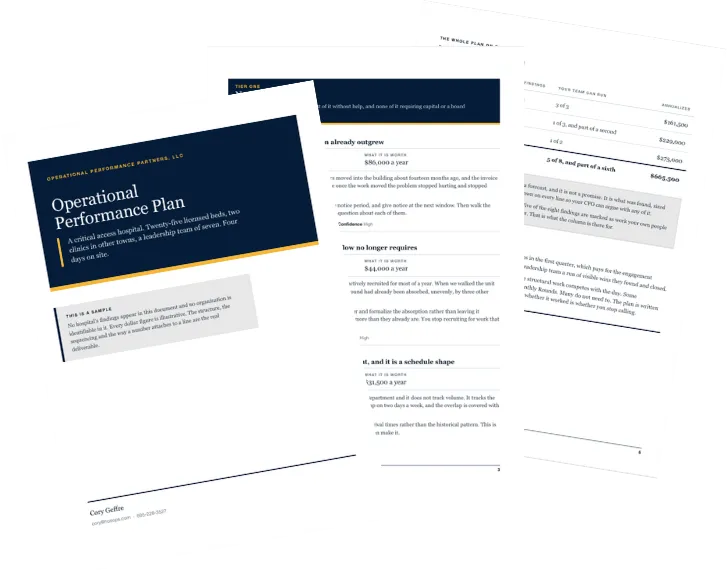
PDF. Send it to your CFO if it is useful.
Who this is built for
Critical access and small rural community hospitals
With a leadership team of six to eight. That is not a limitation, it is the size the program is built around. In a hospital your size I can usually reach the whole operation in three to four days, and every leader who needs to be in the room fits in it.
What moves the number is how much operation there is to walk, and it is not only beds. A robust outpatient department is more to cover than a bed count suggests. So are clinics, especially clinics sitting in three or four other towns. Two hospitals with the same license can be very different visits, so we scope it on the call, before either of us is committed.
Day one is free, so the decision in front of you right now is whether to give me one day.
What to expect from the plan
I will find more than you can implement in a year
That is what happens when somebody who has run multiple turnarounds walks a hospital that has not had a focused operational evaluation. And most of what lands in the Now and Next tiers, your own leaders can run without me.
The plan will say so, in writing, item by item.
I am not building a case to sell you something bigger... I am handing you a year of work and teaching
your people to do it.
And some of it will not be right for this year, which is a real answer rather than a stall. A service line in transition, a community that has watched too much change already, a board that needs a quiet quarter... those are reasons to wait, and waiting is a decision you are allowed to make.
I once worked for a CEO who wanted shelf-ready plans. When the environment moves, you do not want to start looking then. You want to already know what your options are, what each one is worth, and what it would take to run it.
That is what the Later tier is for. Named, priced, and parked, so the month something changes you are choosing from a list instead of building one.
The second half
Twelve months with your team
A plan is not the hard part. Executing it is, and a plan that arrives without a way to run it becomes an expensive document in a drawer.
So the twelve months are implementation, not instruction. Your directors run the changes in the plan. They are the ones standing in front of their own staff, and that is not a courtesy... it is the point.
I am a phone call. Once a month with the group, and reachable in between when something does not go the way we drew it. Expertise in their back pocket, and nobody new in your hallway.
That is what makes it hold after I am gone. Work your own people ran is work that stays. Work somebody else ran tends to leave when they do.
Operational Team Coaching. $3,500 a month, twelve months.
Priced separately from the $25,000, and decided after you have read the plan.
Your operational leaders round their own areas between sessions and bring back what they found. We work it together, once a month, virtually, alongside a six-module curriculum they apply on their own floor between sessions. Progress runs against the plan you already have. I meet with you separately, so the room where your leaders talk stays a room where they do not go quiet.
Twelve months, then it ends or we build a new set of outcomes and decide again. The point is that by the end of it your team is rounding without me. If they still need me in year two, I did it wrong.
There is a leadership development side to this work as well. Ask me about it if you want the two paired.
Who I am
An experienced hospital operator who is also a registered nurse
I have been a chief nursing officer and a system CNO, and over the last decade I have been the operational VP responsible for three consecutive hospital turnarounds.
I have sat in the chair your chief nurse and your operational directors are sitting in.
That is why I can talk to your clinical leaders without them going quiet, and why what I teach them tends to stick.
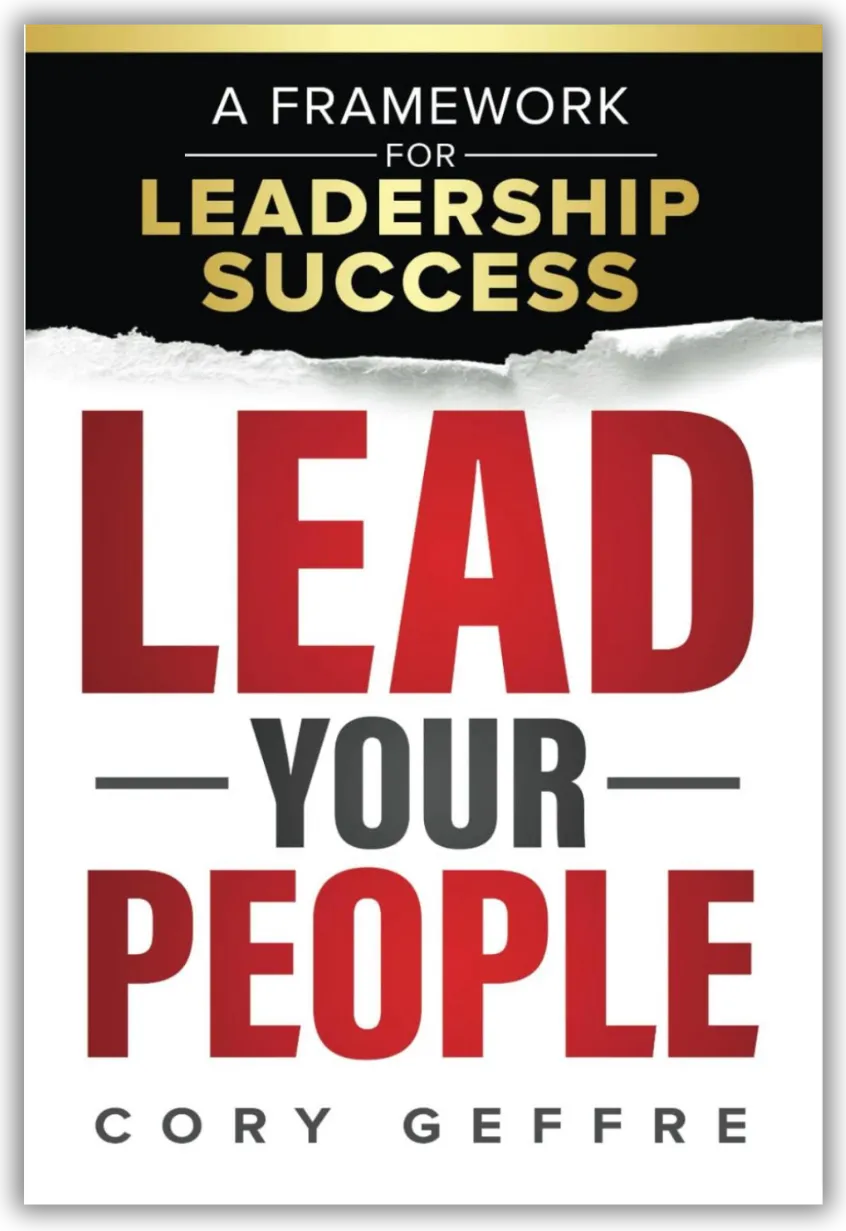
Lead Your People
Framework for Leadership Success
Rooted in real-world experience, this book walks you through the five essential skills of leadership mastery: developing people, managing performance, building teams, improving operations, and achieving results.
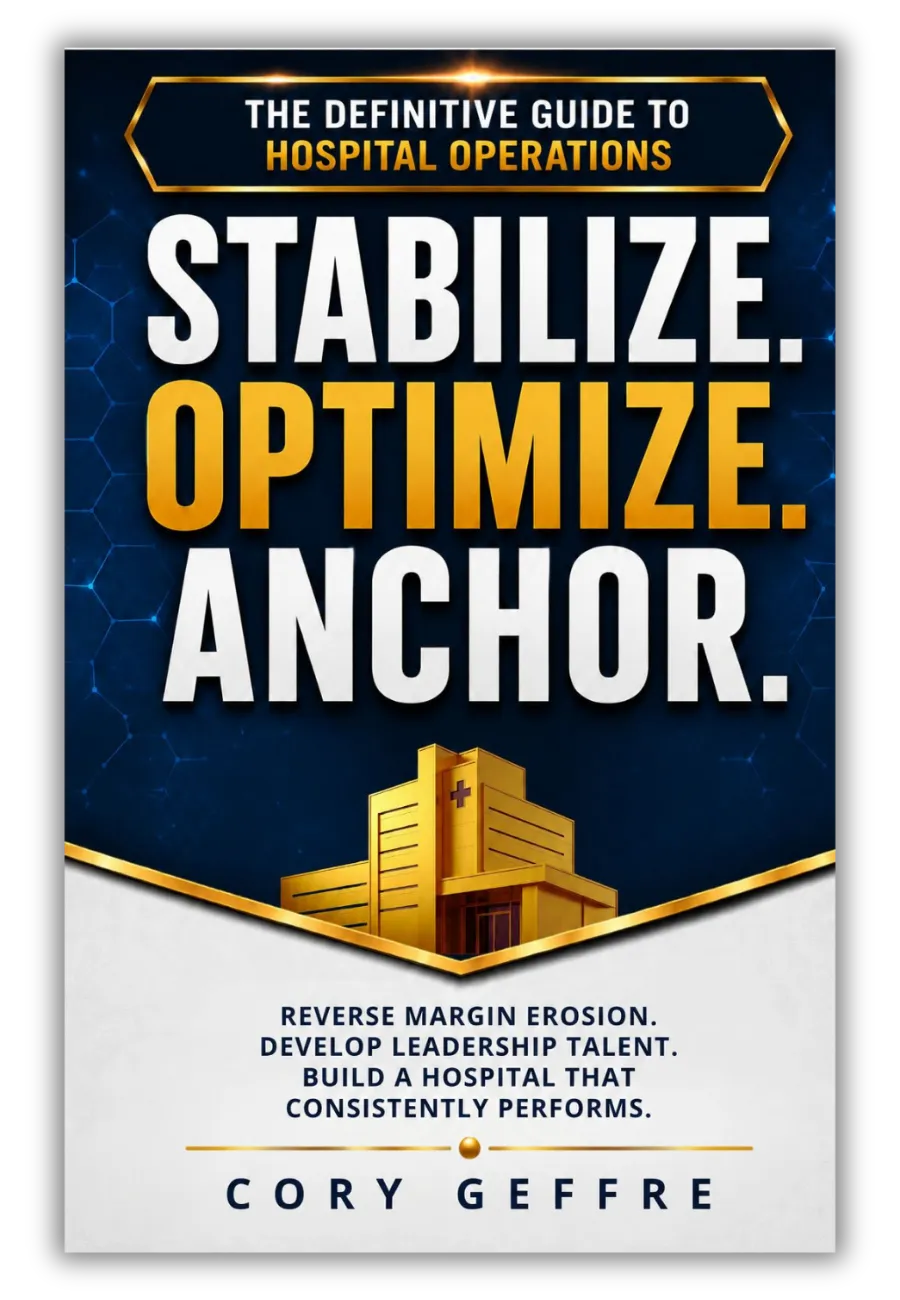
Stabilize. Optimize.
Anchor.
The Definitive Guide to Hospital Operations
After a decade of executive hospital leadership across facilities from 25 to 267 beds, Cory Geffre hands operators a precise, tested build sequence for the operating system nobody ever finished.
coming soon
coming soon
Lead Your People
Framework for Leadership Success
Rooted in real-world experience, this book walks you through the five essential skills of leadership mastery: developing people, managing performance, building teams, improving operations, and achieving results.
Stabilize. Optimize. Anchor
The Definitive Guide to Hospital Operations
After a decade of executive hospital leadership across facilities from 25 to 267 beds, Cory Geffre hands operators a precise, tested build sequence for the operating system nobody ever finished.
To start
Let's talk. One twenty-minute phone call.
Call or text me at:
Email me at:
605-228-3527
[email protected]
Call or text me at: 605-228-3527
Email me at: [email protected]
Call or text me at: 605-228-3527
Email me at: [email protected]
Cory Geffre
Operational Performance Partners, LLC
Hosops.com
Operational Performance Partners, LLC
Hosops.com
Operational Performance Partners,
LLC hosops.com